Commodity
What are you hauling—produce, meat, frozen food, dairy, beverages, or another product?
Reefer Dispatch Services
Reefer freight is not one-size-fits-all.
Two loads can run the same miles and still be completely different moves because of the commodity, temperature requirements, appointment timing, facility delays, reefer fuel, washouts, lumper requirements, destination, and reload market.
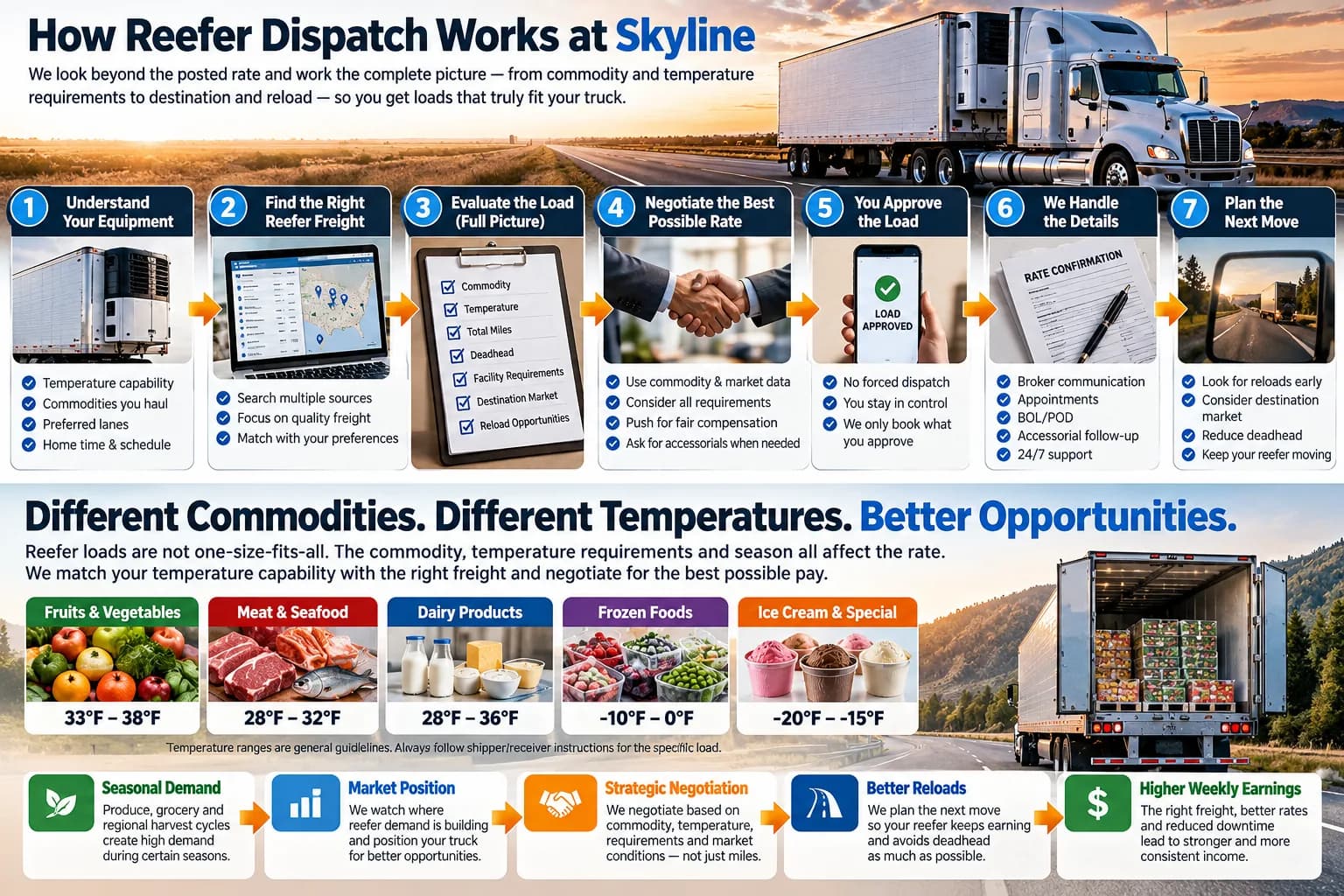
Skyline gives your reefer operation a dedicated dispatcher who looks beyond the posted rate—finding the right freight, negotiating the load, reviewing the details, planning the lane, and working on the next move while you stay in control of every booking.
Best Rates in the Market Dedicated Dispatcher No Forced Dispatch Lane & Reload Planning 24/7 Support
Direct Answer
A reefer dispatch service helps refrigerated carriers find and evaluate temperature-controlled freight, negotiate rates, communicate with brokers, coordinate appointments and instructions, organize dispatch paperwork, handle applicable accessorial issues, and plan reload opportunities.
Skyline does not judge a reefer load by the posted dollars and loaded miles alone.
We look at the commodity, temperature instructions, total miles, deadhead, timing, facility requirements, operating exposure, destination, and the market your truck will enter after delivery.
Not Every Reefer Load Is the Same
A 1,000-mile reefer load of fresh produce is not automatically the same move as 1,000 miles of frozen food, meat, beverages, dairy, or another temperature-controlled commodity.
Different freight can bring different temperature requirements, handling expectations, time pressure, facility rules, operating costs, and market demand.
That means we want to know what is inside the trailer before deciding what the load is worth.
What are you hauling—produce, meat, frozen food, dairy, beverages, or another product?
What set-point or operating instructions has the shipper provided?
Can your reefer handle what the load requires?
Is it appointment-sensitive, overnight, multi-day, or likely to consume extra operating time?
Washout, lumper, seals, tracking, driver assist, pre-cool, continuous/cycle instructions, or other requirements.
Where is it picking up, where is it delivering, and what opportunities are waiting on the other side?
Then we negotiate the move based on the whole load, not just what appears on the load board.
Reefer Problems We Help Solve
Problem 1
A strong headline rate can lose its value after deadhead, long receiver waits, reefer fuel, a lumper, a washout, or delivery into a weak outbound market.
Skyline Solution
We evaluate total miles, time, requirements, destination, reload potential, and the work attached to the freight before recommending the move.
Problem 2
The commodity matters. Temperature requirements matter. Appointment structure matters. Season and origin market matter.
Skyline Solution
We review the actual freight before negotiating it. We want to understand whether the load is produce, frozen product, meat, dairy, beverages, or another commodity and what that freight requires from your equipment and schedule. Then we negotiate from there.
Problem 3
Some carriers are willing and equipped to handle a much wider range of temperature-controlled freight than others. A reefer capable of servicing a wider practical temperature range may have access to a broader pool of suitable opportunities when the equipment is capable and the carrier wants that freight.
Skyline Solution
We learn what your unit can actually do and what you are willing to haul. If your operation is flexible, we can search a broader market instead of unnecessarily limiting the truck to one small freight category. More suitable freight options give us more opportunities to compare rates, lanes, timing, and destinations. It does not mean accepting everything. It means having more choices.
Problem 4
Reefer freight changes with harvest cycles, food demand, regional production, and available capacity. The market does not pay the same everywhere all year.
Skyline Solution
We pay attention to where reefer demand is building and what commodities are moving. During stronger seasonal markets, the goal is to position the truck where tighter capacity and freight demand can create better negotiating opportunities. Outside peak periods, the strategy changes. Instead of blindly chasing last month’s hot market, we work the freight available today—lane by lane, commodity by commodity, and market by market.
Season doesn’t stop the strategy. It changes the strategy.
Problem 5
A strong outbound load into a weak reefer market can create a long deadhead, low-paying reload, or a full day waiting for freight.
Skyline Solution
Before booking, we want to know what happens after delivery. We consider the next market when evaluating the current move.
A strong outbound rate matters more when the truck also has a workable next move.
Problem 6
Important details discovered too late can lead to missed appointments, rejected trailers, extra costs, or a load the carrier never wanted.
Skyline Solution
Before booking or pickup, we work to clarify applicable information provided by the broker, including:
You should know what you are agreeing to before the truck is committed.
Problem 7
Reefer waiting can tie up the truck while the refrigeration unit continues operating.
Skyline Solution
We track applicable appointment and facility timing and communicate with the broker. When the situation qualifies, we help organize and pursue the applicable documentation and communication for:
Additional work should not simply disappear from the load file.
Problem 8
That creates avoidable downtime.
Skyline Solution
When timing allows, Skyline starts looking ahead while your reefer is still under the current load. Your dispatcher knows where you are delivering and can begin evaluating the next market rather than waiting until the POD is signed to start from zero.
Delivery Should Be the End of One Load — Not the Beginning of Your Search.
The More We Understand Your Reefer, the Better We Can Work the Market
We want to know your actual reefer operation:
If your equipment and operating preferences give us more room to work, we can compare more suitable freight opportunities. If you have strict limits, we build the search around those limits.
Your truck determines the freight strategy—not a generic dispatch template.
The carrier and driver remain responsible for safely operating the equipment and following the actual shipper and receiver instructions for each load.
Different Freight. Different Strategy.
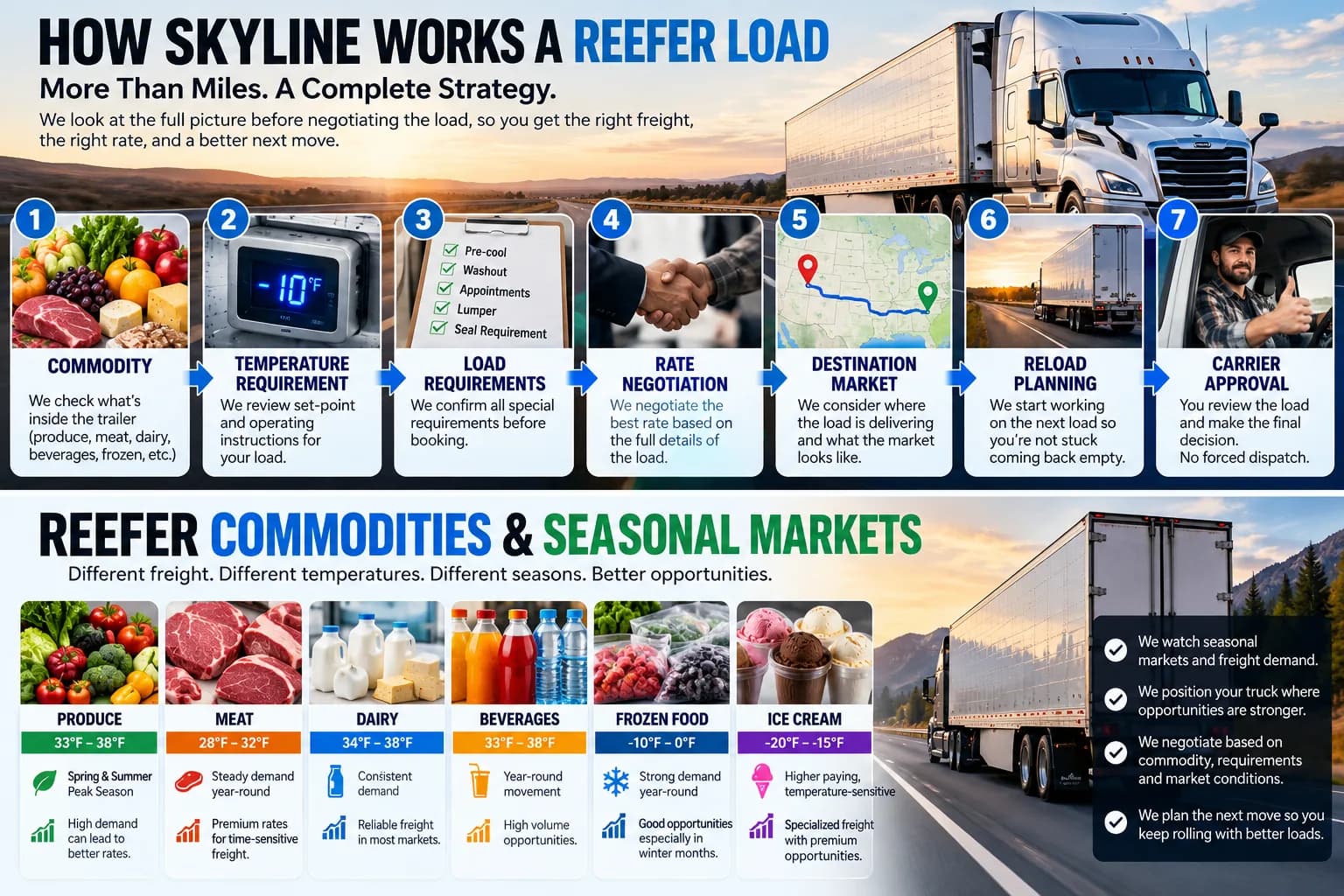
Fresh produce can be highly seasonal and appointment-sensitive. Frozen freight can demand significantly colder operation. Fresh meat and seafood, dairy, beverages, and other refrigerated products can each bring different instructions and operating considerations.
What are we hauling?
What does it require?
What should we be paid to move it?
Not the other way around.
Reefer Freight Moves With the Seasons
Produce season and other food movements can tighten refrigerated capacity quickly.
Regional fruit, vegetable, grocery, meat, dairy, frozen-food, beverage, and other temperature-controlled freight can change where stronger opportunities appear.
Skyline watches the market so your dispatch strategy can change with it.
When a seasonal market is hot, we want to know. When that market cools down, we want the truck positioned for the next opportunity instead of continuing to chase old rates.
Reefer Negotiation Is More Than “Can You Do Better?”
We negotiate using the full picture:
A reefer load that requires more time, tighter conditions, additional work, or delivery into a difficult reload market should not automatically be evaluated like an easy move.
Your Reefer. Your Decision.
We can search broadly. We can negotiate aggressively. We can work different commodities and temperature-controlled freight that fit your unit.
But you approve the load. Nothing gets booked simply because we found it. Tell us what you want to run and what you do not want to run. Then we work the market around you.
Carrier approval stays central.
Build My Reefer Dispatch PlanEquipment, lanes, schedule, home time, commodity preferences, temperature capability, and operating preferences.
Coordinate applicable carrier packets and dispatch-side setup information.
Evaluate rate, deadhead, commodity, timing, temperature instructions, facility requirements, destination, and reload market.
No forced dispatch.
Broker communication, paperwork, accessorial follow-up, delivery coordination, and reload planning.
One Operation. One Dispatcher.
You should not have to explain the same truck, lanes, preferences, equipment, and operating style every morning.
Your dedicated Skyline dispatcher learns your:
That makes it easier to work ahead instead of starting from zero every time you empty out.
Get My Dedicated Reefer DispatcherThe Reload Is Part of the Load
A strong week depends on how the loads connect.
The goal is to reduce unnecessary deadhead and avoid repeatedly ending the truck in markets where the available freight destroys the economics of the previous move.
We plan for the week—not just one load.
Real Reefer Freight. Real Numbers.
Reefer
Chicago, IL Orlando, FL
$4,500
A booked rate is only one piece of the decision. The truck still needs the right commodity fit, workable schedule, destination, and next move.
Find refrigerated freight around equipment, location, schedule, lanes, authority, and preferences.
Call brokers and negotiate instead of automatically accepting posted rates.
Coordinate applicable carrier packets and onboarding information.
Calls, emails, updates, check calls, and load-related communication.
Organize stated commodity, temperature, facility, appointment, and handling information provided for the load.
Review rate, addresses, appointments, commodity information, and stated requirements.
Stay on top of pickup, delivery, relevant schedule changes, and broker communication.
Think about the next market before the current load is complete.
Keep dispatch-related documents organized.
Work around applicable factoring requirements and load documentation.
Work applicable detention, layover, TONU, lumper, washout, driver assist, extra-stop, redelivery, and related issues.
Keep active communication available around the operation.
Straightforward Reefer Dispatch Pricing
Semi Truck Standard
Complete dispatch support for consistent reefer operations.
Semi Truck Premium
Priority load search, stronger lane and reload planning, expanded negotiation and operational support.
Newer MCs can face additional broker restrictions while they build operating history.
Skyline can work around the brokers currently available to your authority while helping coordinate setups and build the dispatch side professionally from the beginning.
Reefer Dispatch Questions
A reefer dispatch service helps with refrigerated load search and evaluation, rate negotiation, broker communication, appointments, dispatch paperwork, applicable accessorial issues, and reload planning.
Different commodities can have different temperature, timing, handling, facility, and market requirements, so Skyline evaluates the actual freight rather than only the miles and posted rate.
Yes. We review the whole move and negotiate with the broker instead of automatically accepting the posted rate.
Skyline organizes and communicates the temperature and operating instructions provided by the broker or shipper.
When those requirements are provided for the load, Skyline works to identify and communicate them before pickup.
Yes. Skyline can coordinate dispatch-side communication, applicable procedures, receipts, and documentation for lumper fees.
Yes. We track relevant timing and communicate regarding qualifying detention, layover, TONU, and related accessorial issues.
No. Skyline does not use forced dispatch. You approve the load before it is booked.
Yes. Preferred lanes, home time, commodity preferences, areas to avoid, and other operating preferences are built into your dispatch plan.
When timing and market conditions allow, yes. Working ahead of the truck is part of Skyline’s dispatch approach.
Yes. Broker eligibility varies, but Skyline can work available opportunities and coordinate applicable broker setups.
Explore New Authority Dispatch SupportSemi Truck Standard is 5% of weekly gross and Semi Truck Premium is 7%.
Your Reefer Can Do More Than Haul Whatever Pops Up First.
Tell Skyline your equipment, temperature capabilities, commodities, preferred lanes, home time, and operating preferences. We’ll work the market around them—searching the freight, evaluating the commodity and requirements, negotiating the rate, handling the dispatch details, and planning the next move.